Edutarbiyah English Blog A Trusted Resource for Parenting, Islamic Tarbiyah & Personal Development
Why Every Family Needs a Vision
Most successful organizations, schools, and businesses operate with a clear vision. Yet many families—the most important institution in society—live without one.
Without a clear vision, parents often find themselves reacting to problems rather than proactively building the family they desire. They may have good intentions, but lack a shared direction.
A Family Vision Statement helps parents answer important questions:
- Who are we as a family?
- What do we stand for?
- What kind of children do we want to raise?
- What values will guide our decisions?
- What atmosphere do we want in our home?
A clear family vision creates unity, purpose, and consistency in parenting and tarbiyah.
What Is a Family Vision Statement?
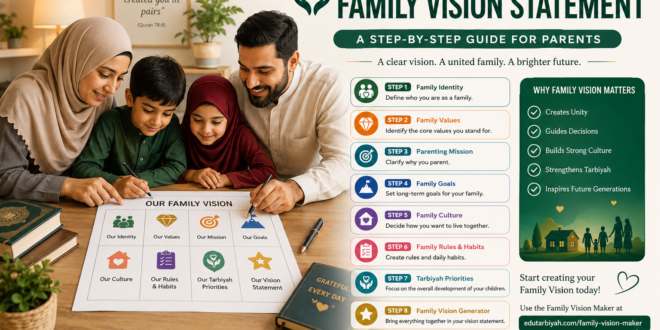
A Family Vision Statement is a written declaration that describes:
- Your family’s identity
- Core values
- Parenting mission
- Long-term goals
- Home culture
- Family habits
- Tarbiyah priorities
It acts as a compass that guides daily decisions and keeps the entire family moving in the same direction.
Instead of merely asking:
“What should we do today?”
A family vision helps you ask:
“Does this action move us closer to the family we want to become?”
Benefits of Creating a Family Vision
1. Creates Unity
Everyone understands the family’s purpose and direction.
2. Improves Parenting Decisions
Parents can make decisions based on values rather than emotions.
3. Builds Strong Family Culture
Children grow up understanding what their family stands for.
4. Strengthens Tarbiyah
Islamic values become part of daily family life.
5. Provides Long-Term Direction
Parents focus on raising future adults, not just managing present behavior.
Step-by-Step Process to Create Your Family Vision
At EduTarbiyah, we have created a free Family Vision Maker tool that guides parents through the entire process.
You can access it here:
Family Vision Maker:
https://edutarbiyah.com/family-vision-maker/
The tool walks parents through the following eight steps.
Step 1: Family Identity (Who We Are)
Start by defining your family’s identity.
Ask:
- Who are we?
- What makes our family unique?
- How do we want others to know us?
Example:
“We are a Muslim family striving to please Allah through faith, character, learning, and service.”
Step 2: Family Values (What We Stand For)
Choose the values that will guide your family.
Examples:
- Faith
- Honesty
- Respect
- Responsibility
- Kindness
- Gratitude
- Excellence
Remember:
Values are not just words; they become standards for family behavior.
Step 3: Parenting Mission (Why We Parent)
Clarify your purpose as parents.
Ask:
- Why are we raising children?
- What is our ultimate parenting goal?
Example:
“To raise children who love Allah, possess noble character, serve humanity, and become a source of goodness for the Ummah.”
Step 4: Family Goals (What We Want to Achieve)
Think long-term.
Imagine your children twenty years from now.
Ask:
- What kind of adults do we want them to become?
- What achievements matter most?
Examples:
- Strong Islamic identity
- Excellent character
- Love of learning
- Emotional maturity
- Healthy lifestyle
- Positive contribution to society
Step 5: Family Culture (How We Live Together)
Culture is how things are done in the home.
Ask:
- What atmosphere do we want to create?
- How should family members treat one another?
Examples:
- Respectful communication
- Peaceful conflict resolution
- Learning together
- Family discussions
- Encouragement instead of criticism
Step 6: Family Rules & Habits
Vision becomes reality through habits.
Create a small set of family rules and daily practices.
Examples:
Family Rules:
- Speak respectfully.
- Tell the truth.
- Pray on time.
- Help one another.
Family Habits:
- Daily Quran reading
- Family meals
- Weekly family meeting
- Gratitude practice
- Reading time
Step 7: Tarbiyah Priorities
A balanced tarbiyah focuses on the whole child.
At EduTarbiyah, we recommend five key areas:
Spiritual Development
Iman, Salah, Quran, Dua
Character Development
Honesty, patience, responsibility
Emotional Development
Confidence, emotional control, gratitude
Intellectual Development
Learning, curiosity, critical thinking
Physical Development
Health, fitness, sleep, nutrition
Step 8: Create Your Family Vision Statement
Now combine everything into one inspiring statement.
Example:
“We aspire to become a family that worships Allah sincerely, follows the Sunnah faithfully, and nurtures an environment of love, respect, learning, and responsibility. We strive to raise children who are strong in faith, noble in character, emotionally balanced, intellectually capable, physically healthy, and socially responsible. Together, we will build a home where every family member feels loved, valued, and empowered to contribute positively to society and the Ummah.”
Review Your Vision Regularly
A family vision is not a document to create once and forget.
Review it:
- Every month
- Every school term
- At the beginning of each year
Celebrate progress and make adjustments when needed.
Final Thoughts
Children do not accidentally become what parents hope for. They become what parents intentionally nurture.
A clear Family Vision Statement transforms parenting from a series of daily reactions into a purposeful journey.
If you want to create a meaningful Parenting & Tarbiyah Vision for your family, use the EduTarbiyah Family Vision Maker and begin building the future of your family today.
Family Vision Maker:
https://edutarbiyah.com/family-vision-maker/
Because a clear vision today creates a better tomorrow for our children.