Edutarbiyah English Blog A Trusted Resource for Parenting, Islamic Tarbiyah & Personal Development
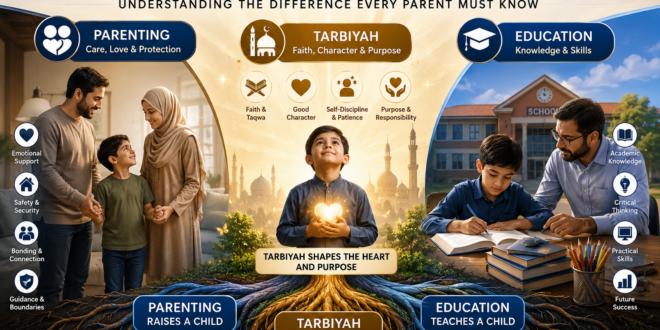
One of the biggest reasons many parents struggle with raising children today is that they unknowingly mix up three different concepts:
Parenting, Tarbiyah, and Education.
Many parents believe that if they provide good schooling, they have fulfilled their responsibility.
Others think that feeding, clothing, and caring for a child is enough.
Some focus heavily on religious teachings but overlook emotional and psychological development.
As a result, children may become academically successful but morally weak, religiously knowledgeable but socially ineffective, or materially comfortable but emotionally broken.
The truth is that Parenting, Tarbiyah, and Education are three distinct yet interconnected responsibilities.
Understanding the difference between them is essential for every parent, teacher, mentor, and educational institution.
This article will clarify these concepts and show how they work together to produce a balanced, successful, and righteous human being.
What is Parenting?
Parenting refers to the process of raising, caring for, guiding, and supporting a child from birth to adulthood.
It focuses on meeting the child’s physical, emotional, psychological, and developmental needs.
In simple words:
Parenting is the relationship and responsibility of parents toward their children.
Parenting involves:
- Providing love and affection
- Ensuring safety and protection
- Meeting physical needs
- Setting boundaries
- Teaching life skills
- Supporting emotional well-being
- Building confidence and self-esteem
Example
A mother comforts her child after a difficult day at school.
A father spends quality time listening to his child’s concerns.
Parents establish household rules and routines.
These are acts of parenting.
Parenting answers the question:
“How do we raise and care for our children?”
What is Education?
Education is the process of acquiring knowledge, skills, information, and intellectual abilities.
It focuses primarily on developing the mind.
Education can occur through:
- Schools
- Colleges
- Universities
- Books
- Courses
- Training programs
- Online learning
Education teaches:
- Mathematics
- Science
- Languages
- Technology
- History
- Professional skills
Example
A child learns mathematics in school.
A university student studies engineering.
A professional attends a leadership course.
These are examples of education.
Education answers the question:
“What does a person know?”
What is Tarbiyah?
Tarbiyah is a comprehensive Islamic concept that means nurturing, developing, cultivating, and gradually helping a person reach their full potential according to the guidance of Allah.
The Arabic word “Rabb” and “Tarbiyah” share the same root.
Just as Allah nurtures and develops His creation, parents are responsible for nurturing and developing their children.
Tarbiyah is much broader than education.
It focuses on:
- Faith development
- Spiritual growth
- Character building
- Emotional maturity
- Moral development
- Good habits
- Responsibility
- Purpose in life
- Relationship with Allah
Example
Teaching a child honesty.
Helping a child develop gratitude.
Training a child to pray regularly.
Building patience and self-control.
Teaching respect for parents and elders.
These are acts of Tarbiyah.
Tarbiyah answers the question:
“Who is this child becoming?”
The Key Difference
A simple way to understand the difference is:
Parenting = Caring
Education = Teaching
Tarbiyah = Nurturing Character and Faith
Parenting focuses on the child.
Education focuses on knowledge.
Tarbiyah focuses on personality and character.
A Practical Example
Imagine a child named Ahmed.
Parenting
Ahmed’s parents provide:
- Food
- Clothing
- Shelter
- Emotional support
- Safety
This is Parenting.
Education
Ahmed attends school and learns:
- Mathematics
- Science
- English
- Computer skills
This is Education.
Tarbiyah
Ahmed learns:
- Honesty
- Respect
- Salah
- Responsibility
- Self-control
- Gratitude
This is Tarbiyah.
All three are necessary.
If one is missing, the child’s development becomes incomplete.
The Problem of Modern Society
Many modern societies focus heavily on education while neglecting Tarbiyah.
As a result, we see:
- Highly educated people lacking integrity
- Skilled professionals involved in corruption
- Intelligent individuals struggling emotionally
- Successful careers but failed family lives
Why?
Because education develops the mind, but Tarbiyah develops the heart and character.
Knowledge alone does not guarantee wisdom.
Can a Child Be Educated but Not Well Raised?
Absolutely.
A child may:
- Earn high grades
- Attend prestigious universities
- Have excellent professional skills
Yet still be:
- Arrogant
- Dishonest
- Selfish
- Irresponsible
Such a person is educated but not properly nurtured.
This is the result of education without Tarbiyah.
Can a Child Receive Tarbiyah Without Formal Education?
To some extent, yes.
History provides many examples of righteous and noble individuals who had limited formal education but possessed:
- Strong faith
- Excellent character
- Wisdom
- Integrity
However, Islam encourages both Tarbiyah and education.
The ideal Muslim seeks excellence in both.
Why Parenting Alone Is Not Enough
Many parents genuinely love their children.
They provide:
- Food
- Clothing
- Comfort
- Entertainment
Yet they neglect character development.
The result is often:
- Entitlement
- Laziness
- Lack of discipline
- Weak resilience
Love without guidance can spoil a child.
Parenting must be supported by Tarbiyah.
Why Education Alone Is Not Enough
Schools can teach information.
They cannot fully teach:
- Character
- Values
- Faith
- Morality
A school may teach a child how to make money.
But who will teach:
- Why honesty matters?
- Why integrity matters?
- Why Allah should be obeyed?
These responsibilities primarily belong to parents through Tarbiyah.
Why Tarbiyah Is the Missing Piece
Many parenting problems today stem from weak Tarbiyah.
Examples include:
Screen Addiction
The issue is not merely technology.
The deeper issue is self-control and discipline.
Disrespect
The issue is not communication alone.
The deeper issue is character development.
Lack of Responsibility
The issue is not intelligence.
The deeper issue is training and nurturing.
Tarbiyah addresses the roots rather than the symptoms.
The Ideal Model: Integration of All Three
Successful child development requires the integration of:
Parenting
Providing love, care, protection, and support.
Education
Providing knowledge, skills, and intellectual growth.
Tarbiyah
Providing faith, values, character, and purpose.
Together they produce:
- Competent individuals
- Responsible citizens
- Strong believers
- Healthy family members
- Effective leaders
A Simple Analogy
Imagine a tree.
Parenting is the Soil
It provides support and nourishment.
Education is the Branches
It provides growth, skills, and productivity.
Tarbiyah is the Roots
It anchors the tree and provides stability.
Without roots, the tree falls.
Without soil, it dries.
Without branches, it cannot grow.
A healthy tree requires all three.
Similarly, a successful child requires Parenting, Education, and Tarbiyah.
The Islamic Perspective
Islam does not separate these responsibilities.
The Quran and Sunnah emphasize:
- Compassion and care (Parenting)
- Seeking knowledge (Education)
- Purification of character and faith (Tarbiyah)
The mission of the Prophets combined all three.
They taught knowledge.
They nurtured faith.
They guided people with compassion.
This holistic model remains the ideal framework for raising children today.
Practical Steps for Parents
To balance Parenting, Education, and Tarbiyah:
1. Strengthen Your Parenting Skills
Learn positive communication, emotional coaching, and child development.
2. Support Quality Education
Help your child develop intellectual and academic excellence.
3. Prioritize Tarbiyah Daily
Focus on character, faith, manners, habits, and spiritual development.
4. Become a Role Model
Children learn more from what they see than from what they hear.
5. Create a Family Vision
Define what kind of person you want your child to become.
Not just what career they should pursue.
Conclusion
One of the greatest mistakes of modern parenting is confusing Parenting, Tarbiyah, and Education.
Parenting provides care.
Education provides knowledge.
Tarbiyah provides character, faith, and purpose.
A child may survive without excellent education.
A child may function without ideal parenting.
But without Tarbiyah, a child risks losing direction in life.
The goal of parents should not simply be to raise educated children.
Nor should it be merely to keep them safe and comfortable.
The real goal is to raise children who are knowledgeable, responsible, morally upright, emotionally healthy, spiritually connected, and beneficial to humanity.
That is the true integration of Parenting, Tarbiyah, and Education.
And that is the foundation of building strong families, strong communities, and a strong Ummah.